Oracy
‘Education gets you to the door, Oracy gets you through the door’
Why Oracy matters?
By teaching students to become effective speakers and listeners we empower them to better understand themselves, each other and the world around them.
- Speaking and listening skills are critical foundations for reading and writing.
- Students with better oral language skills are more likely to achieve the highest grades in GCSE Maths and English.
- Young people with good communication skills are less likely to have mental health difficulties.
As a Voice 21 member school, we aim to put Oracy at the heart of our teaching and learning across all subject areas, enabling students to develop and deepen their knowledge and understanding through talk in the classroom.
We aim to support our students to become articulate communicators who are able to present themselves confidently across a range of settings and contexts, from group discussions to formal presentations.
In Voice 21 Oracy Schools:
- 89% of students agree/strongly agree that speaking and listening has helped them make progress with their school work.
- 77% of teachers said that oracy had boosted attainment.
- 96% of teachers said that oracy is an essential part of teaching and learning.
At St Wilfrid’s, we believe that every pupil should have the confidence, skills and opportunities to express themselves, listen to others and contribute meaningfully to discussions. Oracy is an important part of our curriculum and helps pupils to develop the communication skills they need both in school and beyond.
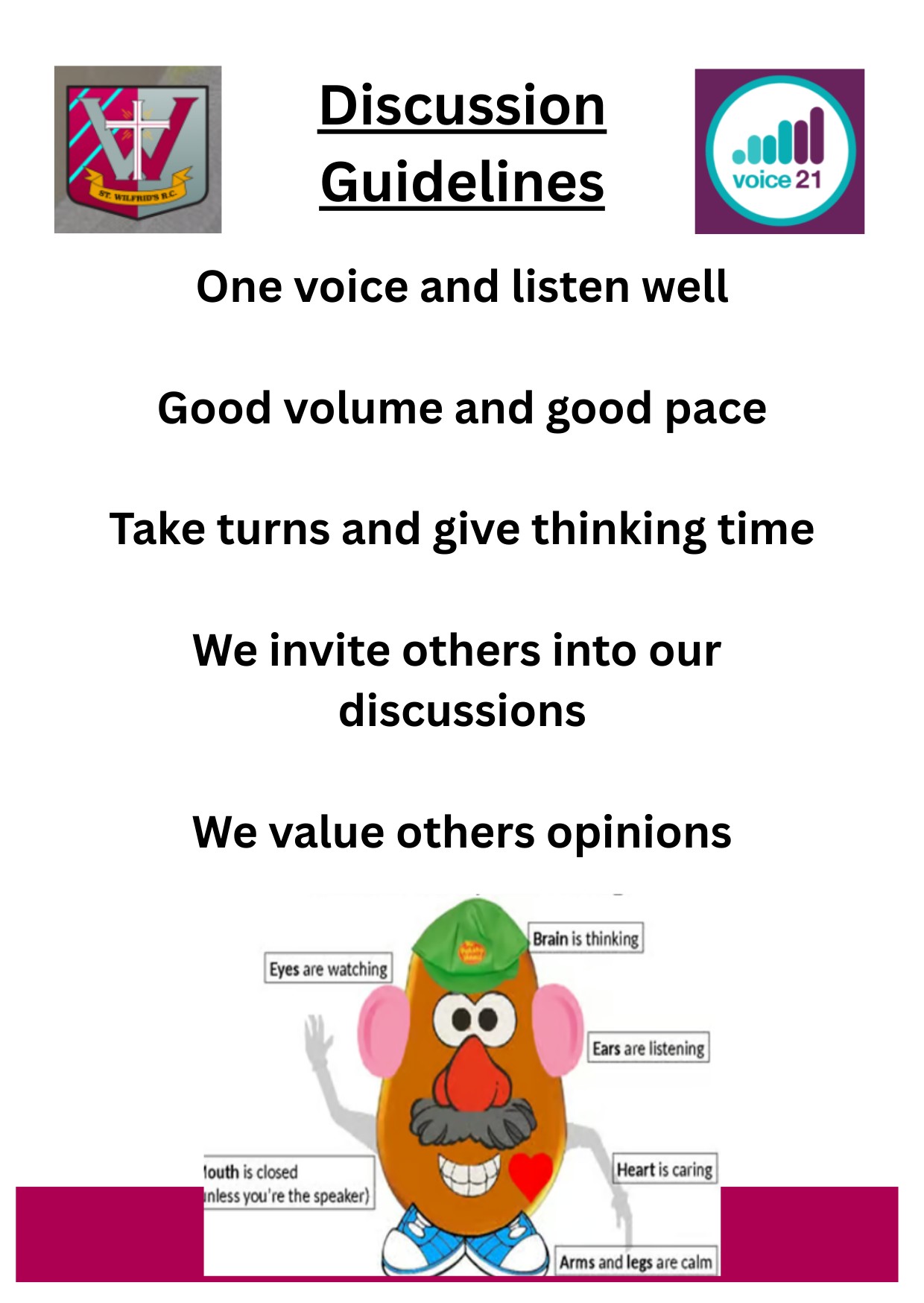
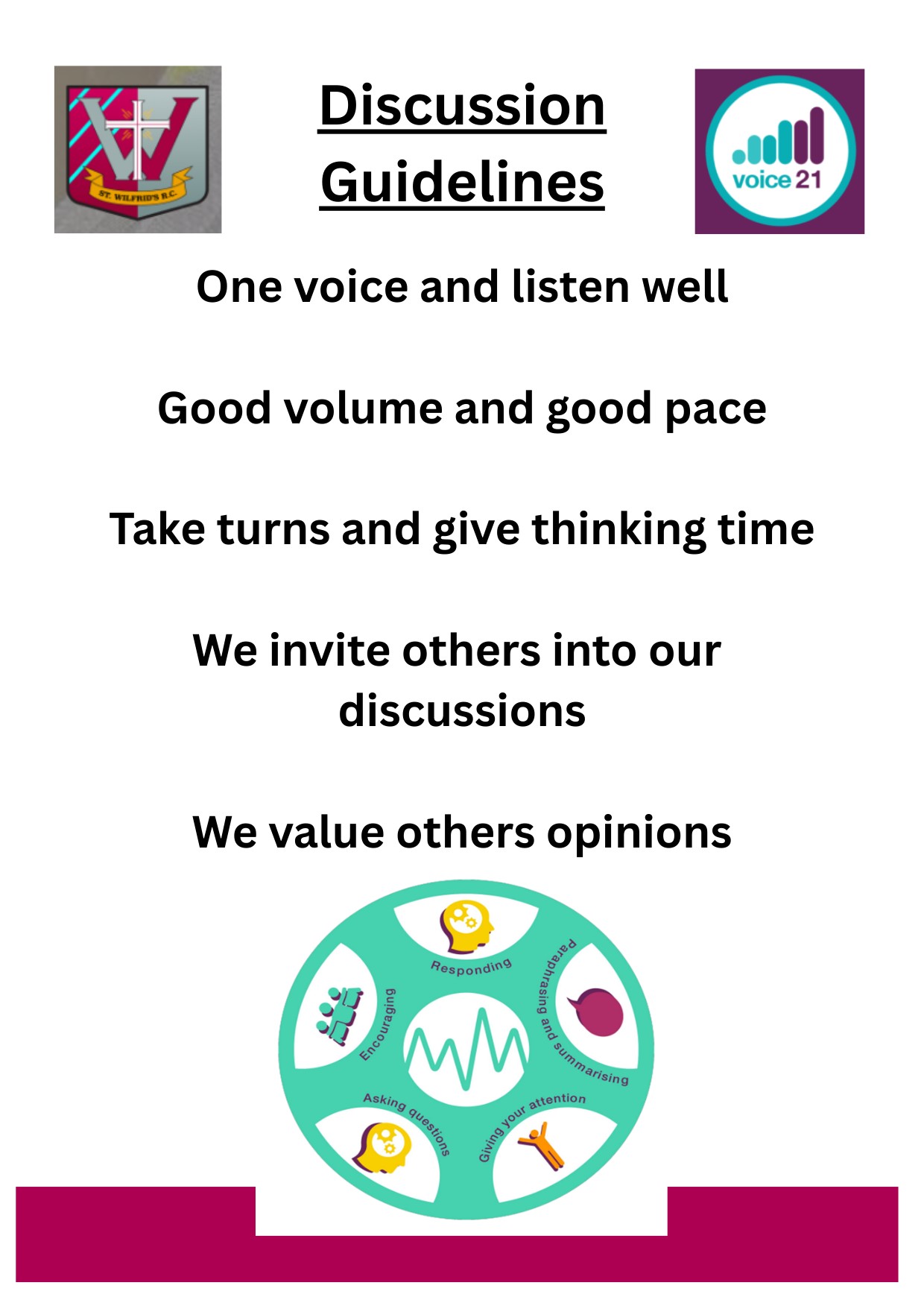
Discussion Guidelines
Our Discussion Guidelines have been developed collaboratively by pupils and staff to establish clear expectations for speaking and listening across our classrooms.
The guidelines ensure that every pupil has opportunities to speak, listen and contribute. They help pupils understand that their voice matters, their ideas will be heard and every voice is important.
Our Oracy Framework
Our teachers use the Oracy Framework, developed by Voice 21 and Oracy Cambridge, to support the development of pupils’ speaking and listening skills.
The framework provides a clear structure for understanding what effective oracy looks like in different contexts. It identifies four interconnected strands:
- Physical – using voice, body language and other physical aspects of communication effectively.
- Linguistic – developing and using vocabulary, sentence structures and language appropriately.
- Cognitive – organising ideas, reasoning, explaining and building on the contributions of others.
- Social & Emotional – developing confidence, empathy, active listening and the ability to work effectively with others.
Using these four strands gives us a shared language for talking about oracy, enables us to establish clear expectations and supports teachers in planning for explicit oracy teaching.
Our Oracy Non-Negotiables
Across the curriculum and in every lesson, we use a number of Oracy Non-Negotiables to ensure that pupils have regular opportunities to develop their speaking and listening skills.
These include:
- Implementing our Oracy Guidelines.
- Using an offering hand to answer and ask questions.
- Using ‘Nest, Pair, Share’ strategies to develop and rehearse ideas.
- Using ‘I say, you say’ to reinforce and repeat key learning.
We use oracy to move learning forwards. By using these strategies consistently and at appropriate points within lessons, pupils are given regular opportunities to articulate their thinking, listen to others and deepen their understanding.
Oracy Resource Bank
Teachers use our Oracy Strategy Resource Bank when planning opportunities for purposeful talk. This includes a range of strategies and activities such as:
- Talk Groups
- Talk Tactics
- Oracy Games
These resources support teachers in creating engaging opportunities for pupils to develop and apply their oracy skills across the curriculum.
The St Wilfrid’s Oracy Curriculum
Our Oracy Curriculum provides planned opportunities for pupils to develop their presentational speaking skills, while also establishing clear expectations for pupil talk across all four strands of the Oracy Framework.
Planned opportunities for talk are closely linked to our PSHCE curriculum and other areas of the National Curriculum, ensuring that oracy is developed meaningfully across pupils’ learning.
Tiered Target Vocabulary for Writing
We want our pupils to encounter, understand and confidently use ambitious vocabulary.
To support this, we have developed a Tiered Target Vocabulary resource which is used alongside our writing units. This helps teachers to identify and explicitly teach vocabulary that will enrich pupils’ spoken and written language.
We are continuing to develop this approach, with the aim of extending our Tiered Target Vocabulary across the wider curriculum.
‘Talker of the Week’
We recognise that oracy is a crucial part of our curriculum and celebrate pupils who make positive contributions to classroom discussion.
Each week, pupils are nominated for our ‘Talker of the Week’ award in recognition of their effective speaking and listening and their commitment to our Discussion Guidelines.
The award is presented during our weekly Gifts from God assembly, celebrating pupils’ achievements with the wider school community.
Listening Walks
We regularly monitor and evaluate the impact of our oracy provision through Listening Walks.
Our Oracy Lead and Oracy Champion use the Teacher Benchmarks to observe oracy practice across the school. These walks help us to ensure that our approach is consistent, effective and, most importantly, helping pupils to develop their confidence and communication skills and move their learning forwards.